

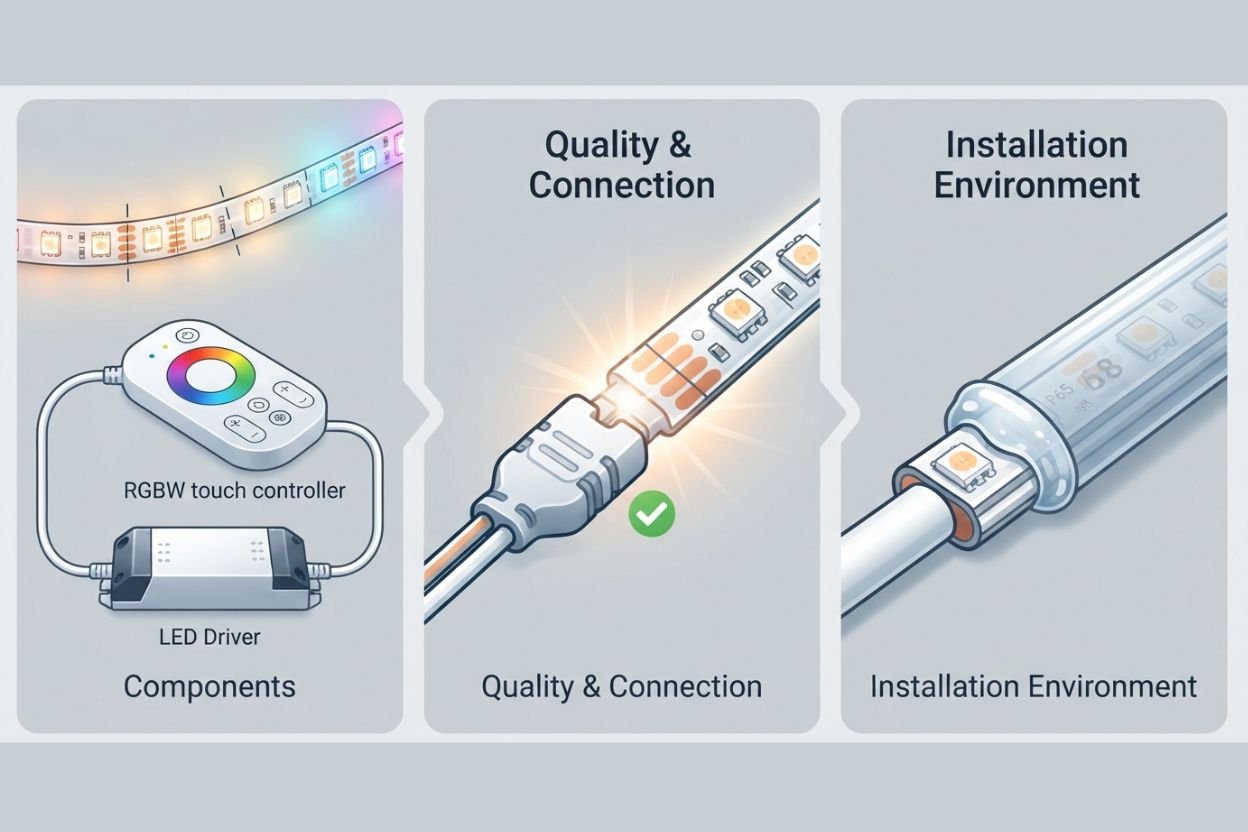
Lighting performance depends on more than selecting a bright LED strip. Every lighting project, whether for residential, commercial, or architectural use, requires compatible components that work together efficiently. The quality of LED strips, controllers, and power supplies directly affects brightness, durability, safety, and long term performance.
As LED technology continues to evolve, users now have access to a wide range of lighting solutions designed for different applications. Understanding how to choose the right components can help ensure consistent results and reduce maintenance requirements over time.
Understanding the Role of LED Strip Lights
LED strip lights have become a popular choice for modern lighting projects because they offer flexibility, energy efficiency, and simple installation. They can be used in cove lighting, architectural lighting, signage, display cases, home decoration, pathways, and commercial environments.
Different LED strip models are designed to meet different requirements. For example, 5050 LED strips can provide 300 LEDs per 5 meters and support applications such as canopies, corridors, windows, archways, and decorative lighting. Some models are available with IP65 and IP68 waterproof ratings, making them suitable for indoor and outdoor installations.
For projects that require colorful lighting effects, RGBW strips combine RGB colors with warm white illumination, creating a more balanced and comfortable lighting environment. Meanwhile, high density COB LED strips provide continuous illumination without visible light dots, resulting in a cleaner visual appearance.
What to Consider Before Selecting LED Strip Lighting
Before purchasing LED strip lighting, several factors should be evaluated.
Brightness is one of the most important considerations. Different LED chips produce different lumen outputs, making them suitable for specific environments. Color temperature is equally important because it influences the atmosphere of the space. Warm white tones between 2700K and 3000K create a comfortable setting, while cooler temperatures support task oriented environments.
Voltage selection also plays a significant role. Many professionals prefer 24V systems because voltage drop is reduced across longer runs. This helps maintain consistent brightness from one end of the strip to the other.
Waterproof ratings should match the installation environment. For outdoor projects, IP65 or IP68 protection can help ensure reliable operation under challenging conditions. An IP68 strip can continue operating even when illuminated at depths of up to three meters without water entering the circuitry.
Installation flexibility is another factor worth considering. Free cutting COB LED strips help resolve installation constraints by allowing more precise adjustments during project planning.
How a Flexible Lighting Solution Improves Different Projects
Modern lighting designs often require products that can adapt to unique layouts and installation conditions. This is where working with a reliable flexible led strip lights factory becomes valuable. Manufacturers with experience in custom production can offer products that support different voltages, waterproof ratings, color options, and cutting configurations.
Flexible LED strips are commonly used in retail displays, hotel interiors, office spaces, exhibition halls, and residential environments. Their ability to follow curved surfaces and fit into narrow spaces gives designers greater creative freedom.
For example, 3528 LED strips feature 300 LEDs per 5 meters and consume only 4.8W per meter, making them suitable for decorative and accent lighting. High voltage 2835 strips offer bright illumination with 550 LEDs per 5 meters, while 3014 LED strips can provide 1200 LEDs per 5 meters for projects requiring greater lighting density.
Many LED strips also feature 3M adhesive backing, allowing quick installation without complex mounting systems. This simplifies deployment and reduces installation time.
Why Power Supply Selection Matters
Even the highest quality LED strip cannot perform correctly without a compatible power supply. The power supply serves as the foundation of the entire lighting system by delivering stable voltage and current to connected devices.
Matching voltage requirements is critical. Using an incorrect power supply can shorten product lifespan or lead to inconsistent performance. Before installation, users should always verify that the power supply specifications meet the requirements of the selected LED strip.
An experienced LED Power Supply manufacturer typically designs products with safety protections, stable output performance, and efficient thermal management. These factors help prevent overheating and contribute to system reliability.
Controllers also play an important role in advanced lighting installations. For instance, RGB touch controllers supporting DC12V to DC24V input can offer multiple color modes, PWM dimming, RF remote control, and operating distances exceeding 20 meters. Such features allow users to customize lighting effects while maintaining stable operation.
Common Mistakes When Pairing LED Strips with Power Supplies
One of the most common installation mistakes is selecting a power supply with insufficient capacity. Every LED strip has a defined power requirement, and the power supply should provide adequate overhead for stable operation.
Another mistake involves ignoring voltage compatibility. Connecting a strip designed for DC12V or DC24V to an unsuitable source can damage the system.
Environmental conditions should also be considered. Outdoor installations may require waterproof components, while industrial settings may demand additional protection against dust and moisture.
Users sometimes focus solely on the LED strip while overlooking controllers, connectors, and supporting accessories. However, all components contribute to overall system performance.
Choosing the Right Manufacturing Partner
The quality of a lighting project often reflects the quality of the manufacturer behind it. A reliable manufacturing partner should offer consistent production standards, quality control processes, technical support, and product customization options.
Shenzhen Dekingled Co., Ltd., established in 2014, manufactures a wide range of LED lighting products including COB strips, RGB strips, neon lights, controllers, and power supplies. The company operates from Building C, SanMing Industrial Park, Shiyan Town, Bao’an District, Shenzhen, China.
Fast delivery, cost effective production, technical support, and quality focused manufacturing are important factors that help customers manage projects more efficiently. Products such as the free cutting 12V and 24V COB LED Strip provide additional flexibility for installers working on custom lighting layouts.
Conclusion
Reliable lighting performance begins with selecting compatible LED components. The right combination of LED strips, controllers, and power supplies helps improve efficiency, maintain consistent brightness, and support long term durability.
By evaluating factors such as voltage, waterproof protection, installation requirements, and manufacturer capabilities, project planners can build lighting systems that perform reliably in both residential and commercial environments. Careful component selection today can reduce maintenance concerns and improve overall lighting quality for years to come.
READ MORE: Warsaw in a Long Weekend: A City Break Full of History, Culture and Local
