

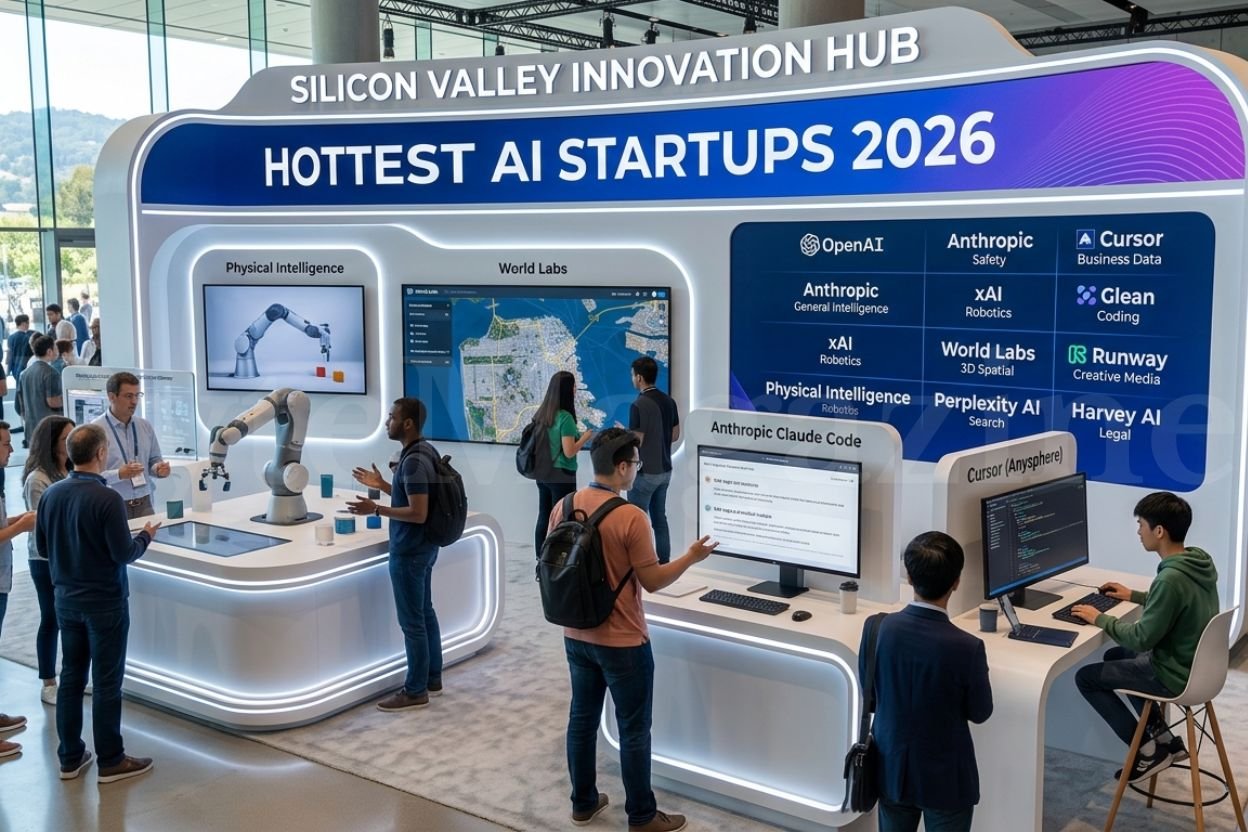
The technological landscape of Northern California has undergone a massive transformation as we move through 2026. Silicon Valley remains the global epicenter of innovation, but the focus has shifted from simple chat interfaces to complex, agentic systems. Many of the hottest ai startups in silicon valley are now building tools that do more than just answer questions; they perform actions, understand 3D space, and manage entire enterprise workflows. These companies are attracting unprecedented levels of capital because they solve deep technical challenges. Consequently, the region continues to pull in the world’s best engineering talent. Understanding these key players is essential for anyone looking to stay ahead in the 2026 digital economy.
The Rise of Agentic and Spatial Intelligence in 2026
Artificial intelligence has evolved significantly from the early days of generative text. Today, the conversation in the Bay Area revolves around “Agency” and “Spatial Understanding.” Agentic AI refers to systems that can plan and execute multi-step tasks across different software platforms without human supervision. On the other hand, spatial intelligence allows machines to navigate and interact with the physical world in three dimensions. As a result, the startups leading the charge in 2026 are those that bridge the gap between digital reasoning and physical or operational reality. This shift marks the beginning of the “Action Era” of computing.
1. Physical Intelligence: The Brain for Robotics
Physical Intelligence has emerged as a top-tier contender among the hottest ai startups in silicon valley. Based in San Francisco, this company is developing a foundational “brain” for hardware. Instead of creating a robot for a single purpose, they are building Large World Models that allow any machine to learn tasks through observation. Therefore, a robot equipped with their software can transition from folding laundry to sorting warehouse bins almost instantly. Because they tackle the hardest part of robotics—generalized dexterity—they have secured massive funding from major venture firms. Their work is a cornerstone for the future of automated manufacturing and home assistance.
2. World Labs: Pioneering 3D Spatial Awareness
Founded by the “Godmother of AI,” Fei-Fei Li, World Labs is one of the most exciting entries on this list. While most models struggle to understand depth and volume, World Labs is teaching AI to see the world in 3D. This capability is vital to industries such as architecture, gaming, and autonomous driving. For example, their technology allows an AI to “imagine” a physical space and how objects move within it realistically. Furthermore, this spatial intelligence is the missing piece for truly immersive augmented reality. Because they address a fundamental limitation of current AI, World Labs is widely considered a “must-watch” unicorn in 2026.
3. Anthropic: The Gold Standard for Enterprise Safety
Anthropic continues to dominate the enterprise sector with its Claude series of models. In 2026, their focus on “Constitutional AI” has made them the preferred partner for healthcare and finance companies. These industries require models that follow strict ethical guidelines and provide reliable, non-hallucinatory data. In addition, Anthropic recently released “Claude Code,” which has revolutionized how developers write and debug software. By prioritizing safety and interpretability, they have built a moat that even the largest tech giants find difficult to cross. Consequently, they remain a primary rival to OpenAI in the race for advanced machine intelligence.
4. xAI: Pushing the Boundaries of AGI
Elon Musk’s xAI has rapidly scaled into a powerhouse within the Silicon Valley ecosystem. In early 2026, the company closed a massive $20 billion funding round to accelerate its quest for Artificial General Intelligence (AGI). Their Grok model is unique because it has real-time access to the flow of information on social platforms. This allows it to stay up to date on global events faster than almost any other system. Moreover, xAI is deeply integrated with Tesla’s and SpaceX’s hardware and robotics. This cross-pollination of data and physical engineering gives xAI a distinct advantage in training models that understand the real world.
5. Perplexity AI: The Conversational Answer Engine
Perplexity AI is successfully redefining how we access information online. Unlike traditional search engines that provide a list of links, Perplexity provides direct, cited answers to complex questions. In 2026, they introduced a “Deep Research” feature that can browse dozens of sources to write a professional-grade report in seconds. Because users value speed and accuracy, Perplexity has seen explosive growth in its subscriber base. There are even reports that major smartphone manufacturers are considering Perplexity as the default search option for their AI-integrated devices. They are a prime example of a startup disrupting a long-standing monopoly through superior AI utility.
6. Glean: The Intelligence Layer for Business Data
Glean has become an essential tool for modern corporations dealing with “data overload.” Their platform acts as a centralized brain that connects to a company’s internal tools like Slack, Jira, and Google Drive. In 2026, Glean launched “Glean Agents,” which can proactively help employees finish tasks. For instance, a Glean Agent can automatically draft an onboarding plan for a new hire by pulling information from previous project documents. By solving the problem of internal knowledge discovery, Glean has achieved incredible revenue growth. They prove that specialized, “vertical” AI can be just as valuable as general-purpose models.
7. Anysphere: The Creators of Cursor
Anysphere, the company behind the Cursor code editor, is one of the hottest ai startups in silicon valley for developers. Cursor has become the industry standard for “AI-native” programming. Unlike traditional editors that added AI as a plugin, Cursor was built from the ground up to understand entire codebases. In 2026, their “Composer” feature lets developers describe a feature in plain English and watch the AI write code across multiple files. This has led to a massive increase in developer productivity. Because they have captured the hearts of the engineering community, Anysphere is currently one of the fastest-growing unicorns in the valley.
8. Runway: Leading the Generative Video Revolution
Runway is the undisputed leader in AI-generated media and cinematography. Their Gen-3 and Gen-4 models allow creators to generate cinematic-quality video from simple text or image prompts. In 2026, Runway is no longer just a tool for social media creators; it is being used by major film studios for pre-visualization and special effects. Additionally, their “Act-One” feature enables realistic facial expression transfer, transforming character animation. By lowering the cost and technical barrier of video production, Runway is democratizing the art of filmmaking. Their impact on the creative economy is both profound and permanent.
9. Harvey: Revolutionizing the Legal Industry
Harvey is a standout example of how AI can transform a traditional, high-stakes profession like law. This startup provides a platform specifically designed for lawyers to perform research, draft contracts, and analyze massive legal datasets. In 2026, Harvey has become a standard tool in almost every major global law firm. The model is trained on specific legal language, ensuring that its output is both accurate and compliant with current regulations. However, Harvey focuses on augmenting lawyers rather than replacing them, allowing professionals to focus on high-level strategy. This focus on a high-value niche has made Harvey a highly profitable and respected entity.
10. Cognition AI: The First Fully Autonomous Software Engineer
Cognition AI made waves with the release of Devin, an AI agent capable of handling entire engineering projects on its own. While other tools assist humans, Devin can plan, code, debug, and deploy software autonomously. In 2026, Cognition has expanded this technology to help companies maintain legacy systems and migrate old code to modern languages. This level of autonomy represents a major shift in how software is built. Consequently, many businesses are using Cognition’s agents to bridge the talent gap in specialized engineering fields. Their success highlights the growing demand for AI that can “do” rather than just “suggest.”
Why Silicon Valley is Still the King of AI
Critics often wonder if Silicon Valley can maintain its lead as AI becomes a global phenomenon. However, the 2026 data shows that the region’s dominance is actually increasing. The reason is the “density of talent” found in San Francisco and Palo Alto. When a new breakthrough occurs, the researchers are often within walking distance of the venture capitalists who can fund them. Furthermore, the presence of massive compute clusters and data centers in the region provides the necessary infrastructure for training large models. This unique combination of brainpower, hardware, and capital makes the valley an unbeatable engine for AI growth.
Investment Trends: From Models to Applications
In 2026, the venture capital landscape in Silicon Valley has matured. While the early years were focused on “Foundation Model” labs, the current trend is “Applied AI.” Investors are now looking for startups with a clear path to revenue by solving specific problems in specific industries. This has led to a surge in funding for healthcare AI, legal AI, and manufacturing automation. Therefore, the hottest ai startups in silicon valley are often those that have deep domain expertise combined with cutting-edge machine learning skills. This shift toward pragmatism is a sign that the AI industry is moving from a hype cycle into a phase of real economic impact.
The Challenges of Scaling AI in 2026
Despite the incredible growth, these startups face significant challenges. The cost of electricity and specialized chips remains a major hurdle for scaling large models. In addition, there is a growing debate around “AI Sovereignty” and data privacy, leading to stricter regulations. Startups must navigate these laws while continuing to innovate at a rapid pace. There is also the risk of “model collapse” if AI systems are trained too heavily on synthetic data. To stay on top, the companies on this list must find ways to access high-quality, human-generated data while making their systems more energy-efficient.
Future Outlook: What to Expect in 2027 and Beyond
Looking ahead, the next frontier for these startups will likely be “Multimodal Integration.” This means AI that can seamlessly switch between hearing, seeing, speaking, and acting. We will see more humanoid robots powered by Silicon Valley software entering the workforce. Additionally, the line between software and AI will continue to blur until every application we use is AI-native. The startups that survive and thrive will be those that can turn advanced research into products that people use every single day. Silicon Valley’s story is far from over; it is simply entering its most intelligent chapter yet.
Conclusion: Navigation the AI Innovation Wave
The hottest ai startups in silicon valley are not just building software; they are building the foundation of a new era. From the 3D understanding of World Labs to the autonomous engineering of Cognition AI, these companies are pushing the boundaries of what is possible. While the competition is fierce, the potential rewards for society are even greater. By automating the mundane and enhancing the creative, these startups are freeing human potential for higher-level work. As we continue through 2026, staying informed about these innovators is the only way to understand the direction of our digital future. The intelligence revolution is here, led by the visionaries of the San Francisco Bay Area.
READ MORE: Sandra Zober: The Untold Story of the Woman Behind the Spock Legend
