

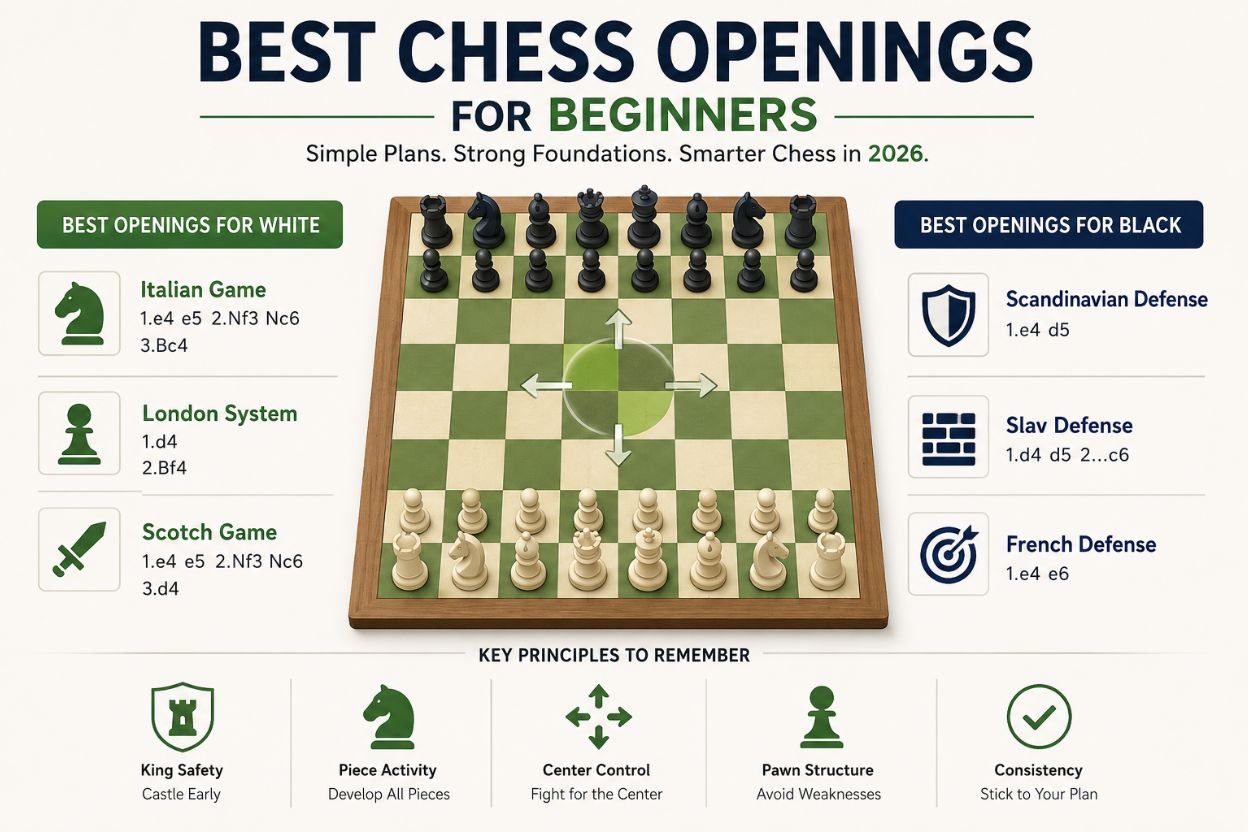
Starting your chess journey is an exhilarating experience. Many novices feel overwhelmed by the sheer volume of theory, but success does not require memorizing thousands of variations. Instead, your growth depends on mastering the best chess openings for beginners. By focusing on sound principles and logical development, you create a structure that helps you transition smoothly from the opening phase into a dominant middlegame.
The Core Philosophy of Opening Play
Every move you make in the first ten turns serves a specific purpose. If you ignore this, you invite disaster. In 2026, the most successful learners prioritize “active piece play.” This means you must move your pieces toward the center and keep them mobile. If a piece remains stuck on its starting square, it contributes nothing to your strategy. Furthermore, you must prioritize king safety above all else. Castling early protects your king and connects your rooks, which is a vital step for any player using the best chess openings for beginners.
Understanding Central Control
Control of the center remains the single most important concept. When your pawns occupy the central squares, they restrict your opponent’s movement and create space for your pieces. Consequently, your knights and bishops gain more influence. If you fail to contest the center, your opponent will likely launch a crushing attack. Therefore, every strategy within the best chess openings for beginners must address the need to challenge the middle of the board immediately.
Why Simplicity Beats Complexity for Beginners
Many beginners waste time studying complex, sharp openings that grandmasters play. However, these positions require deep calculation and precise theoretical knowledge. If you miss one precise move, the game often ends in a loss. Instead, choose reliable systems. Simple openings allow you to focus on your general strategy rather than worrying about tactical traps. By keeping things simple, you build a foundation that is both stable and highly effective for your level.
The Best Chess Openings for White
As the player with the first move, you hold a slight advantage. You should aim to maintain this edge by playing systems that offer clear, logical plans. Because players often seek the best chess openings for beginners, White players should focus on the following recommendations for 2024.
The Italian Game: A Blueprint for Success
The Italian Game begins with 1.e4 e5, followed by 2.Nf3 Nc6, and concludes with 3.Bc4. This setup is legendary for its educational value. It places your bishop on an active diagonal, looking directly at the opponent’s f7-pawn, which is often the weakest point in the Black camp. Additionally, this opening prepares you for quick castling. It is a fantastic choice because it encourages you to play aggressively while keeping your king safe and your pieces developed.
The London System: The Universal Weapon
If you want an opening, you can play against almost any Black setup; the London System is perfect. Starting with 1.d4 and quickly bringing your bishop to f4, you create a “pyramid” of pawns. This structure is incredibly sturdy. Moreover, it allows you to play with a consistent plan regardless of what your opponent does. Because it relies on a specific shape rather than long memorization, it remains the most popular choice for those researching the best chess openings for beginners worldwide.
The Scotch Game: Open and Direct
Another excellent choice for White is the Scotch Game, which starts with 1.e4 e5, 2.Nf3 Nc6, and 3.d4. This move immediately challenges the center and forces Black to react. By exchanging pawns, you open up lines for your pieces. Consequently, the game becomes more tactical and intuitive. Many players prefer this because it leads to active piece play early on, a great way to learn to coordinate your army.
The Best Chess Openings for Black
Playing as Black involves responding to White’s first move. Your primary objective is to neutralize the first-move advantage. Once you achieve equality, you can look for opportunities to take control of the game. When evaluating the best chess openings for beginners, players should consider these robust defensive options.
The Scandinavian Defense: Neutralizing Pressure
The Scandinavian Defense starts with 1.e4 d5. Although some traditional coaches advise against moving the queen early, this opening is highly effective for beginners. It forces White to resolve the tension in the center immediately. Furthermore, it simplifies the game, which helps you avoid complex tactical headaches. You can develop your pieces to natural, comfortable squares without worrying about a wave of attacking play from White.
The Slav Defense: A Solid Wall
Against the popular Queen’s Gambit, the Slav Defense stands as a pillar of stability. By playing 1.d4 d5 and supporting your d5-pawn with 2…c6, you maintain a strong central presence. Moreover, this structure prevents many of the tactical blunders that often occur in the opening. It is a great choice for players who enjoy a slower, more positional battle. By choosing this, you ensure that you will not lose the game in the first ten moves.
The French Defense: Counter-Attacking Potential
The French Defense begins with 1.e4 e6. While it leads to a slightly cramped position for your light-squared bishop, it creates a very strong pawn structure. This defense allows you to launch a counter-attack against White’s center later in the game. It is a strategic choice that rewards long-term planning over short-term tactics. Additionally, it is an excellent way to learn about pawn chains and their influence on the entire game.
Avoiding Common Pitfalls
New players often make the mistake of chasing “trick” openings. These openings might seem exciting, but they usually lead to poor development if your opponent knows how to defend. If you rely on traps, you will stop learning how to play a real game. Therefore, you must focus on sound development. Always ask yourself if your move improves your position or is just a hope for a blunder.
The Danger of Moving the Same Piece Twice
A very common error is moving the same piece multiple times before your other pieces are even developed. This is a massive waste of time. Your goal should be to bring all your pieces into the game as quickly as possible. If you leave your minor pieces on their starting squares, you are essentially playing with only half an army. Consequently, your opponent will easily overwhelm you.
Strengthening Your Chess Intuition
Consistent improvement requires regular practice and self-reflection. Instead of playing fast “bullet” games, play longer games where you have time to think. During these games, try to follow the opening plans you have learned. After the game ends, take a moment to look at your moves. Did you violate any principles? Did you leave your king in the center? By analyzing your own play, you will identify areas for improvement.
The Role of Technology in 2026
Modern chess engines are powerful tools, but you should use them carefully. Do not just look at the computer’s top suggestion. Instead, try to understand the logic behind the move. Ask yourself why one move is better than another. Does it control more space? Does it improve piece coordination? This mindset turns a simple analysis session into a deep learning experience.
Essential Habits for Long-Term Growth
To become a strong player, you must develop specific habits. First, make sure you focus on your own development before launching an attack. Second, always watch your opponent’s threats. Many beginners become so focused on their own plan that they miss a simple attack from their opponent. Therefore, you must remain vigilant throughout the entire game. As you master the best chess openings for beginners, remember these core tenets:
- King Safety: Always aim to castle before move 10.
- Piece Activity: Every piece should have a purpose.
- Center Control: Always fight for the e4, d4, e5, and d5 squares.
- Pawn Structure: Avoid creating unnecessary weaknesses in your camp.
- Consistency: Stick to your chosen repertoire until you understand it deeply.
Developing Your Middlegame Transition
The transition from the opening to the middlegame is where many players struggle. Once your pieces are developed and your king is safe, look for a plan. Are there weak pawns you can target? Is there an open file where you can place your rook? By having a clear plan, you avoid aimless moving. Remember, the best opening is just the starting point. Your success depends on your ability to improve your position move by move.
Final Advice for Your Chess Journey
Mastering the best chess openings for beginners is a rewarding goal. While theory is important, your passion for the game matters more. You should choose openings that you actually enjoy playing. If you love aggressive, sharp games, the Italian Game is perfect. If you prefer a solid, quiet game, the London System or Slav Defense will serve you better.
Ultimately, chess is a game of constant learning. You will lose games, and that is perfectly fine. Each loss provides a lesson that you can use to become stronger. Stay curious, keep your plans simple, and enjoy the beauty of the board. By following these principles, you will notice your game improving significantly. Keep practicing, stay patient, and enjoy your journey to becoming a skilled chess player in 2026 and beyond.
READ MORE: Vçç: The Ultimate Guide to Emerging Digital Frameworks in 2026
