

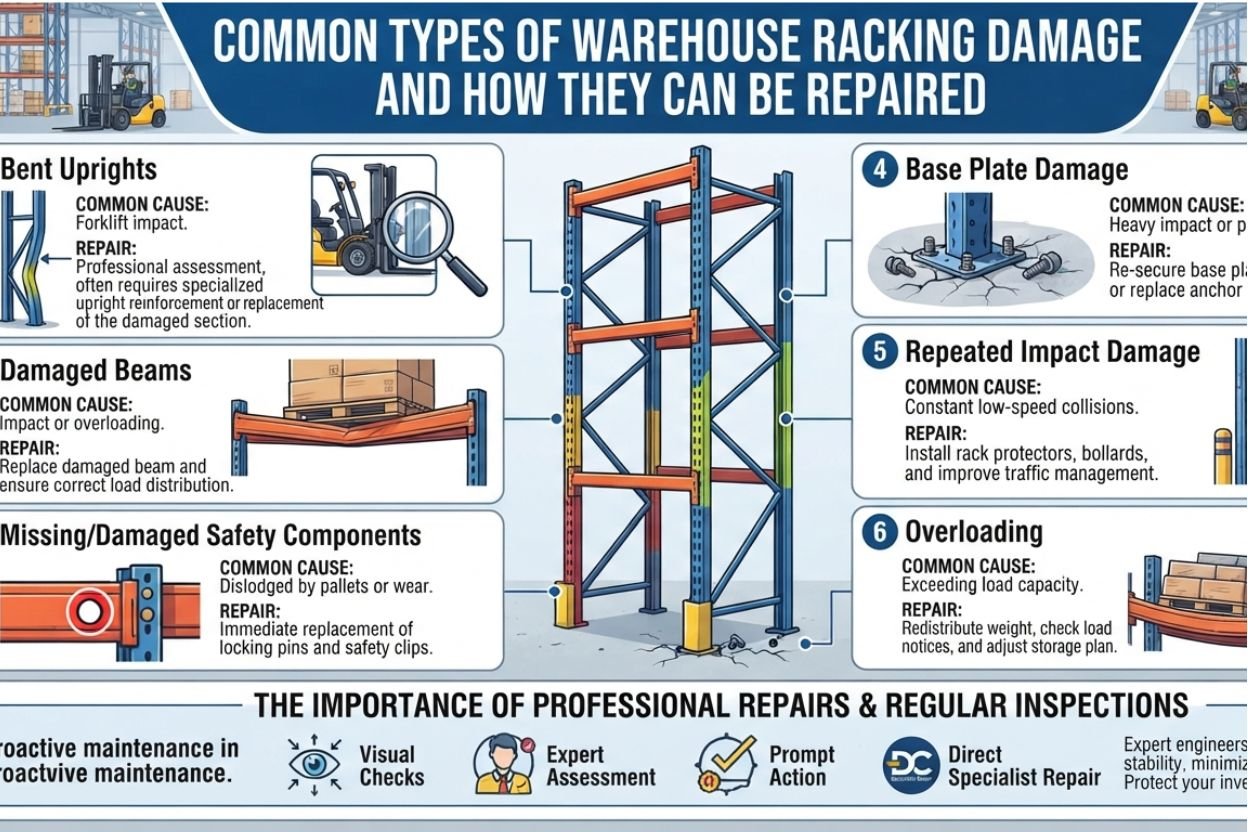
Understanding the Most Common Causes of Damage
Pallet racking is built to withstand demanding warehouse environments, but no storage system is immune to damage. Every day, forklifts move heavy loads through narrow aisles, pallets are placed onto beams, and stock is continually moved in and out of storage. Over time, this level of activity takes its toll.
Some damage is immediately obvious, while other problems develop gradually and are only discovered during routine inspections. Knowing what to look for allows businesses to act early, reducing both safety risks and repair costs.
The sooner damage is identified, the easier it is to restore the system to a safe condition.
Why Professional Racking Repairs Matter
When damage is found, professional racking repairs help restore the strength and stability of the storage system without replacing more components than necessary. Well-planned racking repairs allow businesses to maintain safe warehouse operations while reducing downtime and avoiding unnecessary expense.
Rather than treating every damaged section as a replacement project, experienced engineers assess the extent of the problem before recommending the most appropriate solution. In many cases, repairing the damaged area is all that is required to return the racking to a safe working condition.
Companies such as DC Direct provide specialist repair services for warehouses across the UK, helping businesses deal with damage quickly and efficiently.
Bent Uprights
One of the most common forms of damage is a bent upright. This usually happens when a forklift clips the front of the racking while manoeuvring pallets into position.
Even a relatively small bend can reduce the load-bearing capacity of the upright. Because uprights carry the weight of every beam level above them, damage should never be ignored.
Professional assessment determines whether the upright can be repaired or requires replacement.
Damaged Beams
Beams support the pallets stored on the racking system. Impacts from forklifts or incorrectly positioned pallets can cause beams to bend or become dislodged.
Signs of beam damage include:
- Visible bending
- Twisting
- Damaged end connectors
- Loose beam connections
Damaged beams should be inspected promptly, as they directly affect the safe support of stored goods.
Missing or Damaged Safety Components
Beam locking pins and other safety devices are small components that perform an important job.
If these parts become damaged or go missing, beams may become unsecured during normal warehouse operations.
Although replacing these components is often straightforward, failing to do so creates unnecessary risks that could easily be avoided through routine inspections.
Base Plate and Floor Fixing Damage
The stability of pallet racking depends on secure floor fixings.
Heavy impacts can damage base plates or loosen anchor bolts, reducing the stability of the entire frame.
Inspectors will normally check that:
- Base plates remain securely fixed
- Anchor bolts are tight
- There are no cracks around the fixing points
- The frame remains correctly aligned
Problems in these areas should always be addressed promptly.
Repeated Impact Damage
Not all warehouse damage is caused by one significant collision.
Many warehouses experience repeated low-speed impacts in the same locations over several years. While each individual impact may appear minor, the cumulative effect can weaken the structure considerably.
This type of damage is particularly common near aisle entrances, busy loading areas and locations with limited manoeuvring space.
Installing rack protection and improving traffic management can help reduce repeated impacts.
Overloading
Pallet racking is designed to operate within specific load limits.
Problems arise when:
- Pallets exceed the designed weight
- Loads are distributed unevenly
- Incorrect pallet sizes are used
- Additional beam levels are installed without recalculating capacity
Overloading places excessive stress on structural components and can lead to permanent deformation over time.
Clear load notices and proper staff training help prevent these issues.
Why Regular Inspections Make a Difference
Routine inspections allow businesses to identify damage before it develops into a serious problem.
Warehouse staff should carry out regular visual checks and report any concerns immediately. Professional inspections provide a more detailed assessment and help determine the correct repair strategy.
Working with specialists such as DC Direct ensures that repairs are completed in accordance with recognised industry guidance and that damaged components are dealt with appropriately.
Combining inspections with prompt repairs allows warehouses to maintain safe storage systems while avoiding unnecessary disruption.
Protecting Your Warehouse Investment
Pallet racking represents a significant investment for most businesses. Looking after that investment means more than simply replacing damaged components when something goes wrong.
A proactive maintenance programme should include:
- Regular visual inspections
- Annual professional inspections
- Immediate reporting of impacts
- Prompt repair of damaged areas
- Ongoing staff awareness and training
This approach helps extend the lifespan of the installation while reducing long-term maintenance costs.
Final Thoughts
Damage to pallet racking is an unavoidable part of operating a busy warehouse, but allowing that damage to remain untreated can lead to far more serious problems. Understanding the common types of damage makes it easier to identify issues early and arrange the appropriate action.
Professional racking repairs provide an effective way to restore damaged storage systems, improve workplace safety and reduce unnecessary downtime. By working with experienced specialists and maintaining a proactive inspection programme, UK businesses can protect both their employees and their warehouse infrastructure for years to come.
READ MORE: BGD55 Provides a Secure Online Space for Digital Entertainment
